Rug cleaning: a complete guide to daily care

If your windows are grimy, everything looks grey – as the German saying goes. Cleanliness is held in high regard accordingly, and taken as a measure of a well-kept way of life. The rug has made its way to the centre of our shared living spaces and remains as popular as ever. At the heart of the living-room setting, the rug is the highlight and the eye-catcher of many seating areas, even when the floor covering itself is parquet, laminate or another material. But how do you actually clean a rug?
Rugs are also classified by surface structure
Rugs are further classified by their surface structure – that is, the arrangement of cut and loop – into bouclé, velour and loop pile. Depending on fibre length, the individual rug types divide again into short-pile and long-pile rugs.
While short-pile rugs with a fibre length of less than 1.5 cm can be cleaned with a brush attachment, safely lifting clinging dirt particles and lint, loop-pile rugs and long-pile rugs should only be vacuumed with the smooth nozzle attachment.
Ways to clean a rug right through to the base
There are essentially three cleaning methods for a rug: basic cleaning, intensive cleaning and stain treatment. In principle it is worth distinguishing between daily or weekly cleaning and a deep clean carried out once a year.
Careful handling has a decisive influence on a rug's condition, so material compatibility and suitability come first, before the rug is even put into use. Let us start, though, with what every rug needs at least once a week.
Basic cleaning and weekly rug care
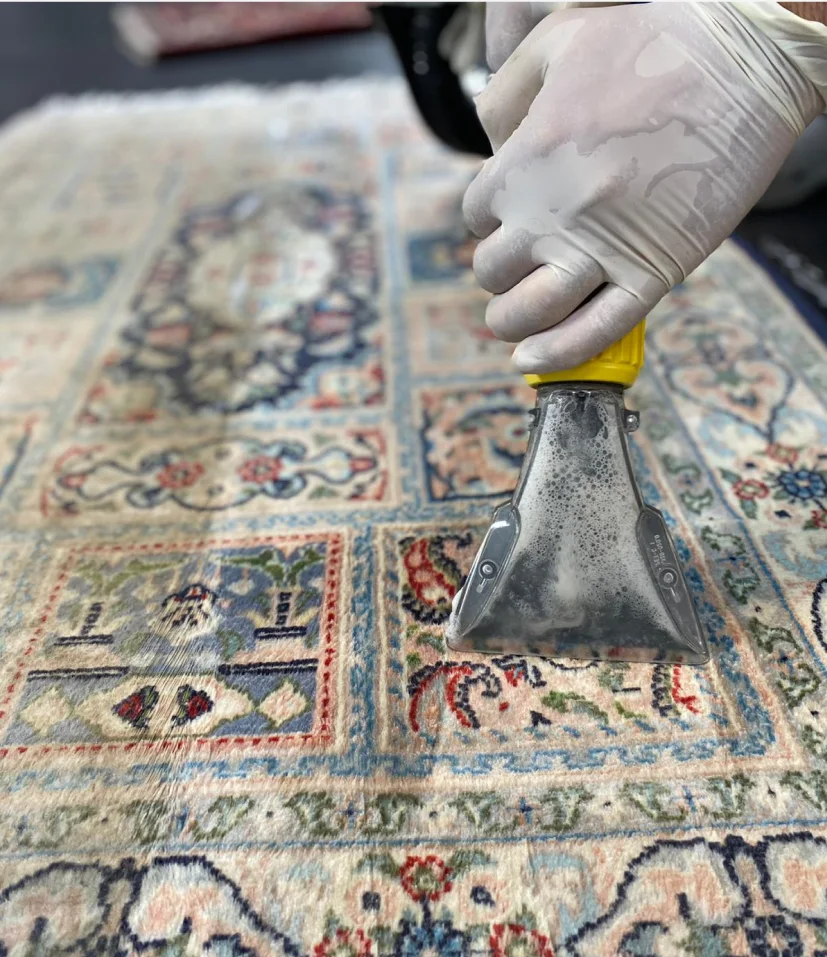
Vacuuming is part of the daily or weekly care of a rug; for a deep clean, Morgenland offers cleaning and repair, and enquiries go through the form. Follow the care instructions on the underside of the rug as well.
The distinction between manufacturing process and surface structure puts the use – or non-use – of a brush attachment at the centre of the cleaning process. First you need to distinguish between hand-knotted, woven and machine-made rugs.
Every rug needs an intensive clean once a year
Rugs under especially heavy use, in the hallway or the children's room need an intensive clean once a year, to preserve the look and the appeal of this piece of home furnishing. There are essentially three different methods for caring for and cleaning a rug: damp cleaning, wet cleaning and steam cleaning. Some types of rug can also be cleaned in the washing machine, which applies above all to very light, thin rugs. Follow the manufacturer's care instructions.
Damp cleaning calls for a suitable rug foam,
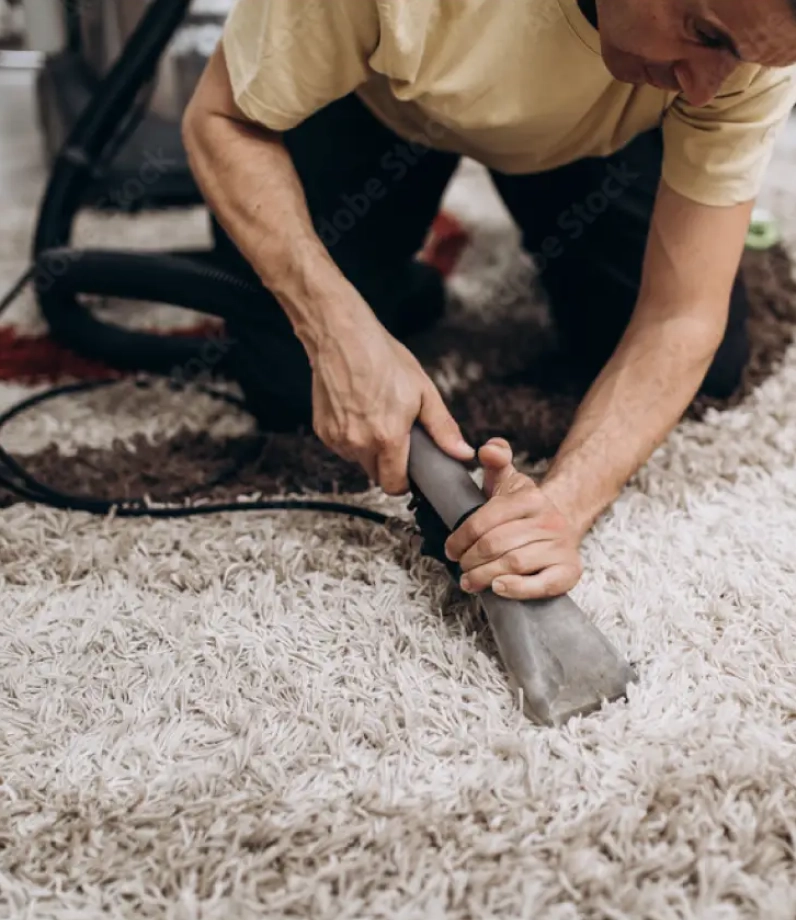
which releases its full cleaning power as it is brushed in. Material compatibility should be tested beforehand on an inconspicuous spot. Once the cleaning foam has dried, it is normally vacuumed back out of the fabric. A wet vacuum, by contrast, is a spray-extraction machine – a special kind of vacuum cleaner with an additional spray nozzle. Adding a cleaning concentrate cleans the rug right through to the base, and it must not be walked on while it dries. Natural-hair rugs such as coir, goat hair or sisal should not be cleaned this way. Here it is essential to follow the manufacturer's instructions.
A stain – now what? This is the moment for quick action
Everyone knows those little stain monsters, the ones that put the fear into a pale rug in particular. Good advice is precious now and should be acted on straight away. If a liquid has been spilled, it should first be soaked up quickly with an absorbent material – a clean cloth, kitchen paper or similar. Loose dirt should be vacuumed up carefully.
When removing stains, bear in mind that some cleaning agents and stain removers do a rug more harm than good. First, though, the soiling itself should be identified more precisely, to establish whether the stain contains proteins, fats, or other organic and inorganic substances. While hydrophobic fats and oils can be treated with surfactants or alkaline cleaners, mild acids are advisable for limescale-based soiling in particular.
For removing food residues, which are made up of several base substances, cleaners containing enzymes are normally used. For quick stain removal, however, lukewarm water alone should first be used to stop the stain spreading further. Dab the stain from the edge inwards with a damp cloth. Never rub or scrub at the rug.
