Since 1977: Your rug specialist
Tradition, expertise & verified quality
Every knot tied by hand: here you will find hand-knotted oriental rugs, mostly from Persia, and learn how to recognise genuine knotting and its fineness.
… Products
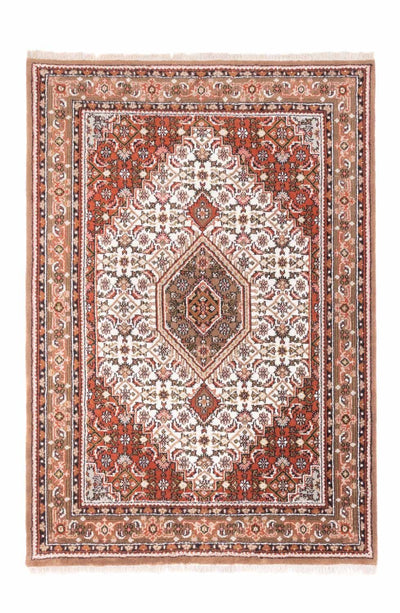

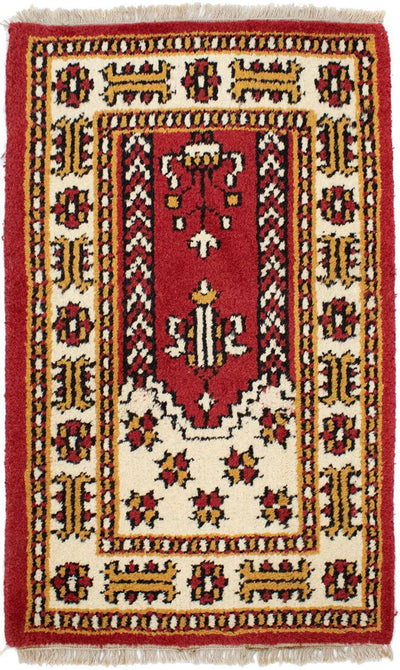


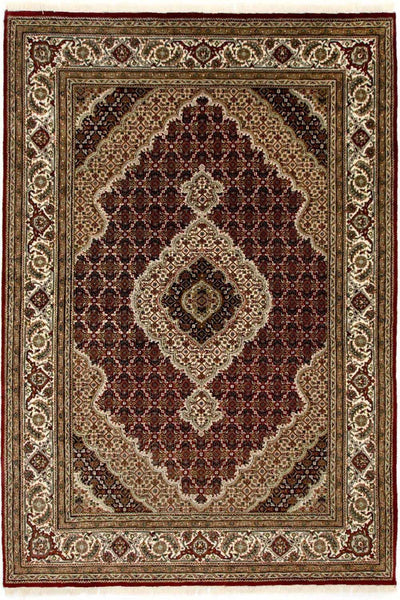
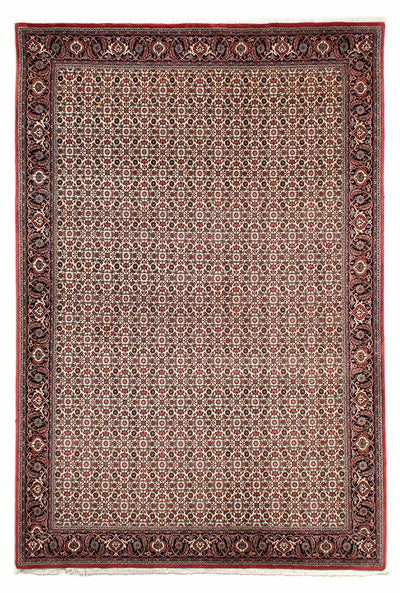


A hand-knotted rug is made on a knotting loom with vertically stretched warp threads. A short piece of yarn is looped around two adjacent warp threads, pulled tight and cut off. Each row of knots is followed by one or two weft threads, which are beaten down with a comb. Together, the yarn ends form the pile. Depending on the fineness, a rug measuring 200 x 300 cm therefore requires hundreds of thousands to several million knots.
The number of knots per square metre shows how fine a rug is. In our range it extends from very coarsely knotted pieces with around 10,000 knots to rugs with more than one million. For Tabriz rugs, Raj stands for the number of knots across a width of around 7 cm: 40 Raj is fine, 50, 60 and 70 Raj are even finer. For Nain rugs, 6La, 9La and 12La denote the quality; here the reverse applies: the smaller the number, the finer the piece.
Turn the rug over. On the back, the pattern is almost as clear as on the front, each knot can be seen individually, and small irregularities in the grid reveal the hand. The fringes are not a sewn-on trim but the ends of the warp threads that run through the entire rug. Machine-made rugs, by contrast, have a uniform back, and tufted rugs often have a glued-on backing.
The pile is mostly new wool, and in many pieces Kurk wool, the fine wool that grows on the shoulder and neck of the sheep. Silk is often knotted into fine rugs; some are made entirely of silk and can be found under Silk Rugs. Most pieces are new; there are also old and semi-antique rugs between 25 and around 100 years old. The value is determined mainly by knot density, material, design, age and condition; well cared for, a hand-knotted rug lasts many decades.
Most come from Iran; find out more under Persian Rugs. A large proportion comes from Afghanistan, along with pieces from Pakistan, India, China and Turkey.
With the symmetrical knot, also called the Turkish knot, the yarn wraps around both warp threads, and both ends emerge between them. With the asymmetrical, Persian knot, only one of the two warp threads is fully wrapped; this allows a particularly fine, curving design.
Yes. A densely knotted wool pile is very hard-wearing, and Bidjar rugs are even considered particularly firm. Vacuum without a rotating brush and have the rug washed by our rug cleaning service every few years.
Tradition, expertise & verified quality
Our rug experts are here to help
Simple & convenient home delivery
The right rug for every style

$38.00